Mature trees are an important part of Lake Oswego’s landscape, providing shade, privacy, natural beauty, and valuable habitat throughout the community. However, even large, established trees can develop structural weaknesses that increase the likelihood of falling branches or complete tree failure.
For homeowners in Lake Oswego, Oregon, recognizing the warning signs of a dangerous tree is especially important during the Pacific Northwest’s wet and windy seasons. Heavy rainfall, saturated soil, strong winds, root damage, and structural decay can all contribute to hazardous conditions.
Whether you own a property in Lake Grove, Mountain Park, First Addition, or another Lake Oswego neighborhood, understanding when a tree may be unsafe can help protect your home, driveway, vehicles, and surrounding property.
At PDX Tree Service, we provide professional tree removal, hazardous tree removal, tree pruning, tree risk assessments, and emergency tree services throughout Lake Oswego and the surrounding Portland metropolitan area.
While not every damaged or leaning tree needs to be removed, certain warning signs deserve prompt attention from a qualified arborist.
Here are seven important signs that a tree on your Lake Oswego property may be dangerous or at risk of falling.
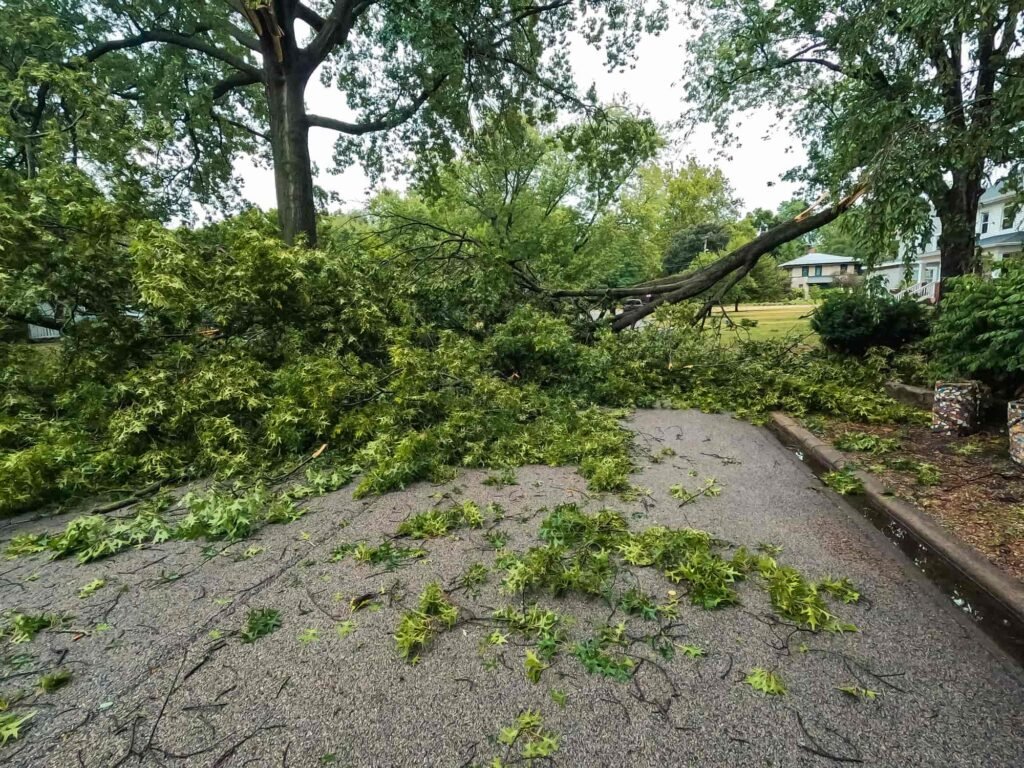
One of the most noticeable warning signs of a potentially dangerous tree is a sudden change in its position.
Many trees naturally grow at an angle and remain structurally stable for decades. However, a tree that begins leaning unexpectedly, particularly after a storm, may have damaged or unstable roots.
For homeowners concerned about leaning trees in Lake Oswego, OR, the most important question is whether the lean is new or has been present for years.
A recent lean accompanied by cracked soil, exposed roots, or ground movement near the trunk can indicate that the root system is no longer providing adequate support.
A tree relies on its root system to remain anchored in the ground. When roots become damaged, decay, or lose their grip in saturated soil, the tree may become unstable.
Lake Oswego’s rainy winters can contribute to soil saturation, making existing root problems more concerning during periods of strong wind.
If a tree suddenly leans toward your home, garage, driveway, or neighboring property, stay away from the area and arrange an urgent professional assessment.
A qualified tree care professional can determine whether the tree requires immediate attention, corrective management, or removal.
Dead and damaged branches are another common indicator of potential tree hazards.
Large branches can fail because of decay, storm damage, improper pruning, or structural weaknesses at their attachment points.
For homeowners researching dangerous tree trimming in Lake Oswego, Oregon, hanging or partially detached branches are among the most important conditions to address.
How to Recognize Hazardous Tree Limbs
Warning signs may include large branches without living foliage during the growing season, cracked branch attachments, broken limbs caught in the canopy, or branches that appear partially separated from the trunk.
Dead branches can fall without the entire tree failing.
This is especially concerning when large limbs extend over roofs, sidewalks, parking areas, or frequently used outdoor spaces.
Professional tree pruning services in Lake Oswego, OR can help remove appropriate dead or damaged branches while preserving the health and structure of the remaining tree.
However, homeowners should never attempt to pull down hanging limbs or cut large branches with a ladder or chainsaw.
Visible cracks or splits can indicate structural problems within a tree.
Some trees develop bark irregularities or natural growth features that are not necessarily dangerous. However, deep cracks extending into the wood, especially around major branch unions, can indicate a weakness requiring professional evaluation.
For homeowners considering hazardous tree removal in Lake Oswego, WA, severe trunk splitting is a warning sign that should not be ignored.
The trunk supports the weight of the tree’s branches and canopy.
When major structural sections begin separating, the tree may have a reduced ability to withstand wind and other external forces.
Trees with multiple large stems growing from the same point can sometimes develop weak attachments, particularly when bark becomes trapped between the stems.
An arborist can evaluate the crack’s location, extent, and relationship to the tree’s overall structure.
Depending on the situation, management options may include selective pruning, structural support, or removal.
A tree with a severe or actively widening crack should be treated as a potential immediate hazard.
Mushrooms and other fungal structures growing directly from a tree’s trunk, roots, or root collar can sometimes indicate internal wood decay.
Although many fungi are harmless or beneficial to surrounding soil, certain species are associated with the breakdown of structural wood.
For property owners concerned about tree decay in Lake Oswego, Oregon, fungal growth attached to a tree deserves a closer look.
Does Fungus Mean a Tree Is Going to Fall?
Not necessarily.
The presence of mushrooms alone does not prove that a tree is unsafe or needs removal.
Some fungi grow on already-dead surface material, while others may be associated with deeper decay.
The risk depends on the fungal species, the location and extent of decay, the amount of sound wood remaining, and the tree’s overall structure.
A professional tree risk assessment in Lake Oswego, OR can help determine whether the condition affects structural stability.
Homeowners should avoid removing fungal growth and assuming the underlying problem has been corrected.
A healthy root system is essential for keeping a mature tree stable.
Tree roots can be damaged by construction, soil excavation, trenching, grading, vehicle traffic, and other disturbances.
In some situations, root damage is visible. In others, the affected roots remain underground, making structural problems difficult to recognize.
For homeowners seeking tree inspections in Lake Oswego, Oregon, changes around the base of a tree can provide important clues about its condition.
Signs of Root Instability
Warning signs may include newly lifted soil on one side of the trunk, cracked ground around the root plate, severed major roots, or a tree that begins moving at the base during windy conditions.
These symptoms can be especially concerning when they appear after heavy rainfall or nearby construction.
Properties throughout Lake Oswego often contain large, established trees close to driveways, patios, retaining walls, and residential structures.
If excavation or landscaping work has disturbed roots near a mature tree, a professional assessment may be appropriate even when the canopy still appears healthy.
Emergency tree removal in Lake Oswego, OR may be necessary when a tree is actively uprooting or presents an immediate danger to people or property.
A tree with significant dead branches, thinning foliage, or widespread canopy decline may be experiencing disease, root damage, environmental stress, or other health problems.
However, normal seasonal leaf loss should not be confused with tree decline.
Deciduous trees naturally lose their leaves during fall, while evergreen species have different seasonal growth patterns.
For homeowners concerned about dead or dying trees in Lake Oswego, Oregon, changes that occur outside the normal seasonal cycle deserve closer attention.
Does a Dying Tree Need to Be Removed?
Not always.
Some trees recover from temporary stress, while others may benefit from appropriate pruning, changes in site conditions, or specialized care.
However, a severely declining tree with extensive dead wood may have an increased risk of branch failure.
The most appropriate solution depends on the tree’s species, structural condition, surrounding targets, and potential for recovery.
Professional tree removal services in Lake Oswego, OR may be recommended when a tree is beyond recovery and creates an unacceptable risk to nearby structures or occupied areas.
Strong winds, heavy rain, and seasonal storms can damage trees throughout the Portland metropolitan area.
Even when a tree remains standing after a storm, major branches may be cracked, hanging, or weakened.
Some trees also develop structural imbalance when one side of the canopy becomes unusually heavy or when previous pruning has left weak branch attachments.
For homeowners needing storm-damaged tree services in Lake Oswego, Oregon, a post-storm evaluation can help identify damage that may not be obvious from the ground.
Can a Storm-Damaged Tree Be Saved?
In some cases, yes.
Selective pruning or other appropriate tree care may help address damaged branches while preserving the tree.
However, extensive trunk splitting, major root failure, or significant structural damage may make removal the safer option.
PDX Tree Service provides professional tree pruning, hazardous tree removal, and crane-assisted tree removal for complex projects involving large trees or limited access.
A qualified arborist can help determine whether a damaged tree can be managed or whether removal is necessary.
Identifying tree hazards involves more than looking for one warning sign.
A tree may contain a structural defect without presenting a high risk, depending on its condition and what could be struck if it fails.
For example, a weakened tree growing in an isolated wooded area may present a different level of concern than a similar tree leaning toward a home or frequently used driveway.
A professional tree risk assessment considers the tree’s condition, likelihood of failure, surrounding environment, and potential consequences.
For homeowners looking for an arborist in Lake Oswego, Oregon, a qualified tree risk assessment can provide more useful information than assuming that every large or leaning tree needs removal.
Not every hazardous tree requires complete removal.
In some situations, professional tree trimming or pruning can reduce risk by removing dead, damaged, or structurally weak branches.
Certain trees may also benefit from properly designed cabling or structural support systems.
However, these methods are not appropriate for every tree.
When a tree has major root instability, extensive decay, severe trunk damage, or other conditions that cannot be adequately managed, removal may be necessary.
For homeowners comparing tree trimming vs. tree removal in Lake Oswego, OR, a professional assessment can help identify the most appropriate approach.
PDX Tree Service provides tree pruning, tree removal, tree cabling, tree risk assistance, and specialized crane-assisted removal services for difficult residential and commercial projects.
Lake Oswego has specific regulations governing tree removal, including trees that are dead, hazardous, or in immediate danger of falling.
Depending on the tree’s condition and classification, homeowners may need to obtain a tree removal permit before work begins.
The city has a Hazard Tree Removal Permit process for qualifying trees that create safety concerns.
In certain circumstances, the city may require supporting documentation from an arborist qualified to perform tree risk assessments.
What About Emergency Tree Removal?
Lake Oswego also provides a process for trees presenting an immediate danger of collapse.
When a qualifying emergency creates an immediate hazard and city approval cannot be obtained before failure is likely, the city’s rules allow necessary emergency action with photographic documentation, followed by an emergency permit application within seven days.
Not every leaning or storm-damaged tree qualifies for this exception.
For hazardous tree removal in Lake Oswego, Oregon, homeowners should confirm the applicable requirements with the city’s Planning Department before proceeding whenever circumstances safely allow.
If a tree has fallen on utility lines, stay clear and contact the utility provider or emergency services.
The cost of removing a dangerous tree depends on its height, trunk diameter, structural condition, location, accessibility, and proximity to surrounding structures.
A large tree near a home or electrical equipment may require more planning and specialized equipment than a smaller tree in an open area.
Other factors may include crane access, rigging requirements, debris removal, stump grinding, and applicable permitting.
For homeowners searching tree removal costs in Lake Oswego, Oregon, the best way to determine pricing is through an on-site estimate.
PDX Tree Service provides professional hazardous tree removal and crane-assisted tree removal for projects where controlled dismantling is necessary.
Homeowners should consider a professional tree inspection when they notice sudden leaning, major dead branches, significant cracks, fungal growth associated with decay, root damage, or substantial storm damage.
An inspection may also be appropriate after nearby construction or excavation that could have affected a mature tree’s root system.
For properties with large trees near homes, garages, or frequently used outdoor areas, periodic professional evaluations can help identify developing concerns.
Tree risk assessments cannot predict every future failure, and even healthy trees can lose branches during severe storms.
However, professional evaluations provide important information about visible and reasonably detectable risk factors.
Lake Oswego contains many neighborhoods with mature landscaping, established trees, and heavily wooded residential properties.
Areas such as Lake Grove, Mountain Park, Palisades, First Addition, and Westlake can present different tree care challenges depending on slope conditions, surrounding structures, and property access.
For homeowners throughout Lake Oswego and Clackamas County, regular tree maintenance and prompt attention to visible hazards can help reduce the risks associated with weakened branches and unstable trees.
PDX Tree Service provides professional tree removal, tree pruning, tree trimming, tree risk assessments, stump grinding, and emergency tree services throughout Lake Oswego and surrounding Portland-area communities.
Common warning signs include sudden leaning, significant trunk cracks, broken or hanging branches, root movement, extensive dead wood, and certain types of fungal growth.
However, an individual symptom does not always establish that a tree is unsafe.
No visual inspection can predict exactly when a tree will fall.
Signs such as newly lifted roots, ground cracking, sudden leaning, or major trunk splitting can indicate an urgent structural concern.
Stay away from an unstable tree and contact a qualified professional.
Not necessarily.
A tree that has grown at an angle for years may be stable, while a tree that begins leaning suddenly may have damaged roots.
A professional arborist can evaluate whether pruning, structural support, or removal is appropriate.
Yes. Dead trees can gradually lose structural strength as wood deteriorates, increasing the possibility of branch or trunk failure.
The actual level of risk depends on the tree’s condition and surroundings.
Many tree removals require permits under Lake Oswego’s tree code.
The appropriate permit depends on the tree’s size, location, condition, and applicable exemptions.
Hazardous and emergency trees have specific procedures.
Sometimes. Removing dead or damaged limbs or correcting certain structural defects may reduce risk.
However, pruning cannot resolve every problem, particularly when the trunk or root system has significant structural damage.
Emergency tree removal costs vary based on tree size, accessibility, damage, equipment requirements, and the complexity of the work.
An on-site assessment is generally necessary to provide a meaningful estimate.
Yes. PDX Tree Service serves Lake Oswego and provides hazardous tree removal, tree risk assessment services, emergency tree removal, tree pruning, and crane-assisted tree removal.
Our team can evaluate the condition of your tree and discuss appropriate management options.
A damaged or structurally weakened tree can pose a serious risk when it stands near a home, driveway, sidewalk, or other frequently used area.
Although many trees remain healthy and structurally stable for decades, warning signs such as sudden leaning, trunk cracking, root instability, and significant storm damage should not be ignored.
For homeowners throughout Lake Oswego, Oregon, professional tree evaluations can help identify concerning conditions and determine whether pruning, structural support, or removal is the appropriate solution.
At PDX Tree Service, we provide professional tree removal, hazardous tree removal, tree trimming, tree pruning, emergency tree services, and tree risk assessments throughout Lake Oswego and surrounding Clackamas County communities.
Whether you’re concerned about a leaning tree, damaged branches, a dead tree near your home, or a large tree requiring specialized removal equipment, our team can help evaluate the situation.
Contact PDX Tree Service to schedule a professional tree assessment or request an estimate for hazardous tree removal in Lake Oswego, OR.